

Inclusive Mainstream Fund: What Can Schools Spend It On?
Every mainstream school in England now has an Inclusive Mainstream Fund (IMF) allocation, sometimes called the Mainstream Inclusion Fund, and an inclusion strategy to publish by 31 December 2026. If you’re wondering what you can spend it on, how to write your inclusion strategy, or how it fits the DfE’s 7 principles of inclusion, this guide covers it. It also explains how assistive technology can be one of the most practical uses of your allocation.
Key takeaways
- The Inclusive Mainstream Fund is a DfE grant worth over £500 million a year for three years.
- Every school must publish an inclusion strategy on its website by 31 December 2026, with planned activities and budgeted costs.
- All IMF spending must fall under one of the DfE’s 7 principles of inclusion and be evidence-informed.
- Assistive technology supports several of the principles directly.
- We’re offering schools a FREE 1:1 consultation and AT review.
What is the Inclusive Mainstream Fund?
The Inclusive Mainstream Fund is ring-fenced funding from the Department for Education. It’s paid to state-funded mainstream schools, colleges and early years settings in England. Its purpose is to help schools build inclusion into everyday teaching: a strong universal offer for every pupil, plus early, targeted support without waiting for a formal assessment or diagnosis.
Schools decide how to use their allocation, alongside their core budget and notional SEN budget, as long as the spending meets the conditions of grant.
What can the Inclusive Mainstream Fund be spent on?
You can spend the IMF on any activity that:
- falls under at least one of the DfE’s 7 principles of inclusion
- is evidence-informed
- addresses barriers to learning and participation in your cohort
The DfE recommends that most schools focus their first year on a small number of high-impact activities in their universal offer. Schools with a strong universal offer already can add targeted support.
Can schools spend the IMF on assistive technology? Yes. Assistive technology supports several of the 7 principles directly, particularly high-quality adaptive teaching and inclusive environments.
What are the DfE’s 7 principles of inclusion?
Every activity funded through the Inclusive Mainstream Fund must fall under at least one of the DfE’s 7 principles of inclusion. Here’s what each principle means and how assistive technology can support it.
- Ambitious leadership and governance that embeds inclusion
Whole-school assistive technology training and services help leaders build a consistent approach to inclusion across every classroom. - Evidence-based support prioritising early intervention
Screening tools help schools spot barriers to learning early, and assistive technology can be offered straight away, without waiting for a formal diagnosis. - High-quality adaptive teaching with a curriculum designed for all learners
Text-to-speech, speech-to-text and word prediction tools let every pupil access the same lesson content in the way that works for them. - Enriching provision beyond the classroom that all children can access
Accessible music and art tools help all pupils take part in clubs, activities and creative subjects. - A safe, respectful culture fostering belonging, attendance and participation
Sensory and calming tools help pupils regulate, feel comfortable and stay engaged in the classroom. - Strong partnerships with families and wider services
Using the same tools consistently at school and at home helps families support their child’s learning and keeps everyone working together. - Inclusive environments with continuous improvements to accessibility
Environmental control, ergonomic equipment, and visual and hearing support make classrooms more accessible for every pupil.
The DfE doesn’t approve specific products or suppliers. What matters is that you can explain which barrier a tool removes, which principle it supports, and how you’ll measure the impact.
When is the inclusion strategy deadline?
Your inclusion strategy must be published on your school website by 31 December 2026, for the 2026 to 2027 academic year. If you write a multi-year strategy, it must be reviewed annually.
What should an inclusion strategy include?
Whether you use the DfE’s inclusion strategy template or your own format, your strategy must cover:
- The barriers to learning and participation identified across your cohort
- The activities you’re investing in to remove those barriers, with budgeted costs
- Your intended outcomes
- A review of the previous academic year
Ofsted’s inspection framework will also look at whether your inclusion strategy is embedded in practice and whether staff are equipped to deliver it. So the activities you choose need a clear plan for training and everyday use. We explain why in Assistive Technology for Dyslexia: Why Buying the Tech Isn’t Enough.
Assistive technology packages for your Inclusive Mainstream Fund
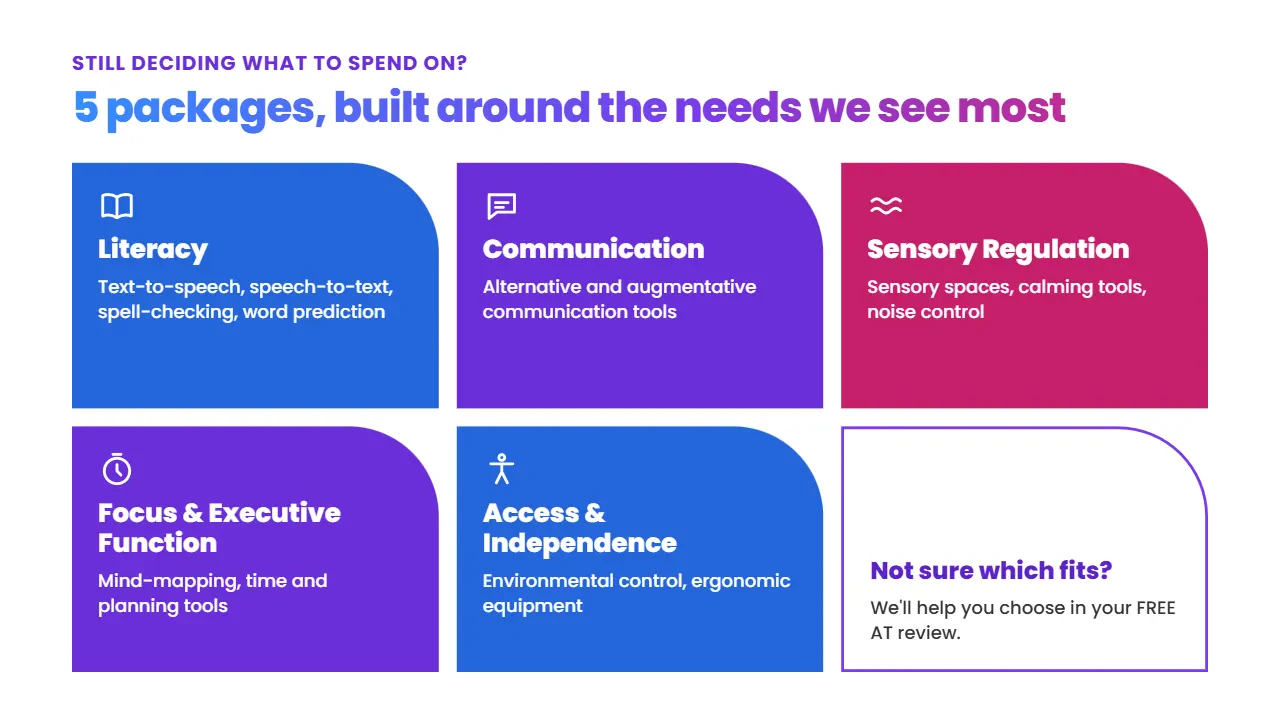
If your allocation isn’t planned yet, these five packages are built around the needs we see most often in mainstream schools:
- Literacy: text-to-speech, speech-to-text, spell-checking and word prediction
- Communication: alternative and augmentative communication (AAC) tools
- Sensory Regulation: sensory spaces, calming tools and noise control
- Focus & Executive Function: mind-mapping and time and planning tools. See also Assistive Technology for ADHD.
- Access & Independence: environmental control and ergonomic equipment
Not sure what fits your pupils? Try our Smart Search to match tools to needs.
Get help with your inclusion strategy: free AT review
We’re assistive technology specialists, not just suppliers, with over 25 years of experience and more than 200 inclusive tools. Here’s how our free support works:
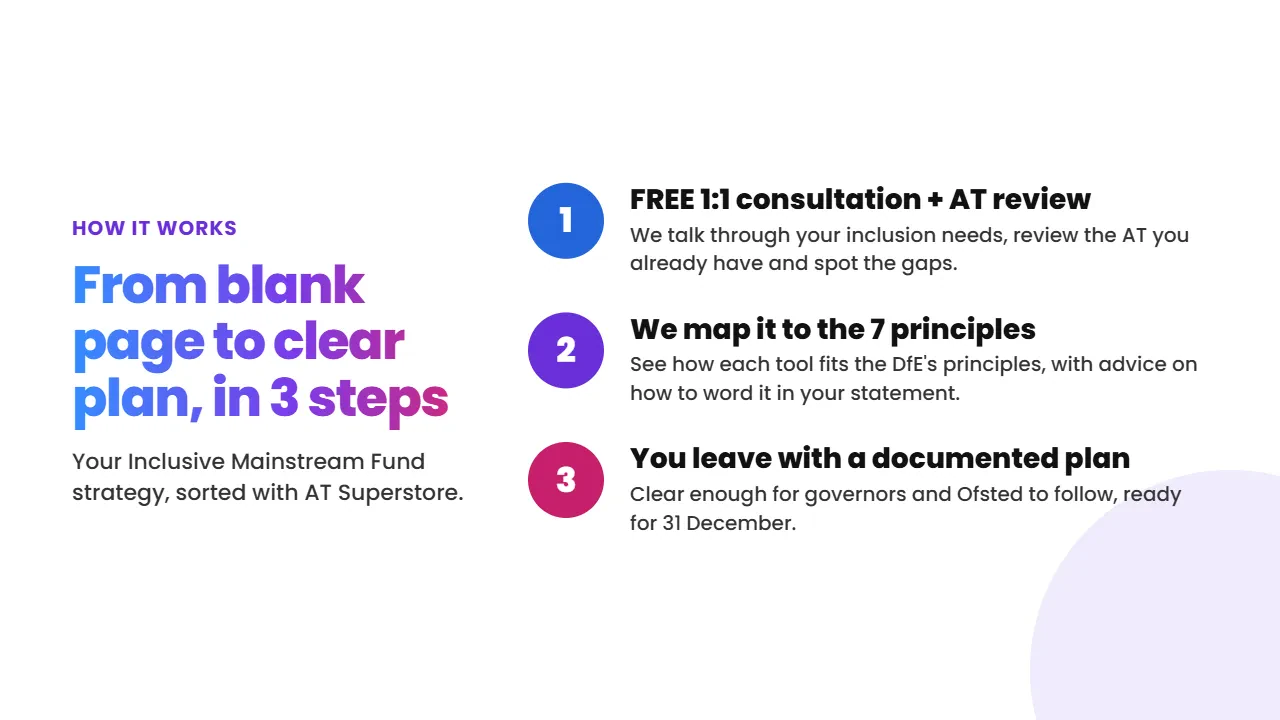
- FREE 1:1 consultation and AT review. We talk through your inclusion needs, review the assistive technology you already have and identify any gaps.
- We map it to the 7 principles. We show how your plans connect to the DfE’s principles and advise on how to word them in your inclusion strategy, so governors and Ofsted can follow it.
- You leave with a clear, documented plan, ready for the 31 December deadline, with staff training so your AT gets used every day.
Book your FREE 1:1 consultation and AT review →
Inclusive Mainstream Fund FAQs
Is the Inclusive Mainstream Fund the same as the Mainstream Inclusion Fund?
Yes. “Inclusive Mainstream Fund” is the DfE’s official name, but you’ll often see it called the Mainstream Inclusion Fund.
Do pupils need a diagnosis to benefit from IMF-funded support?
No. The DfE encourages early, targeted support without the need for formal assessment or diagnosis. Many assistive technology tools also help whole classes as part of the universal offer.
Can the IMF be used for staff training?
Training that helps staff deliver inclusive practice can support the principles, particularly high-quality adaptive teaching and leadership that embeds inclusion. We include training with our AT packages.
Subscribe to our newsletter
The latest accessibility technology news, articles and resources, sent to your inbox weekly.
Images
Categories
- Mind Mapping
- Text to Speech
- Speech to Text
- Spell Checking
- Word Prediction
- Visual Impairment
- Alternative Communication
- eLearning
- Environmental Control
- Sensory
- Time and Planning
- Hearing Impairment
- Note Taking
- Reading and Research
- Training and Services
- Music and Art
- Medical Management
- Ergonomic
- Screening
- Gaming
- Tablets